Uncategorized • October 14, 2026

Buying a Bay Area Home With Solar Panels?

Buying a Bay Area Home With Solar Panels? Here Are 8 Things You Should Know Before You Buy

Meta Description: Buying a Bay Area home with solar panels? Learn about ownership, leases, financing, electric bills, batteries and hidden expenses before purchasing.

Table of Contents

  1. Solar Panels Can Be a Great Feature — But Ask Questions
  2. Are the Solar Panels Actually Owned?
  3. What Happens if the System Is Leased?
  4. Is There an Outstanding Solar Loan?
  5. Will Your Electric Bill Really Be Lower?
  6. What About California’s Solar Billing Rules?
  7. How Old Are the Panels?
  8. Does the System Include Battery Backup?
  9. What Happens When the Roof Needs Replacing?
  10. The Bottom Line

Solar Panels Can Be a Great Feature — But Ask Questions

You’re touring a beautiful Bay Area home.

The kitchen is updated, the backyard is lovely, and the seller proudly announces:

“And the house has solar!”

Wonderful!

But my next question would be:

“Is the solar system owned, financed or leased?”

Because those are three very different situations.

Solar panels can be a wonderful feature, potentially reducing electricity costs and providing renewable energy.

But buying a home with solar isn’t always as simple as inheriting a few panels on the roof.

There may be contracts, financing arrangements, equipment warranties, utility billing considerations and maintenance responsibilities.

Before you get too excited about those panels, here are eight important things to investigate.

1. Are the Solar Panels Actually Owned?

When a listing says a property has solar panels, that doesn’t necessarily mean the seller owns them outright.

Solar systems generally fall into several categories.

Owned outright: The homeowner purchased the system, and there is no remaining financing obligation.

Financed: The homeowner purchased the system using a loan or other financing arrangement.

Leased: A solar company or third party owns the equipment, and the homeowner makes payments under a lease agreement.

Power Purchase Agreement (PPA): A third party generally owns and operates the system, while the homeowner agrees to purchase the electricity it generates under a contract.

These arrangements can have very different implications when the property is sold.

Never assume solar panels are owned simply because they’re attached to the roof.

2. What Happens if the Solar System Is Leased?

Imagine purchasing a home and discovering that the solar panels come with a monthly payment.

Depending on the lease, there may be established payments, annual increases, maintenance provisions and requirements for transferring the contract.

Some solar leases can be financially attractive. Others may be less appealing depending on the terms.

Ask whether you’ll need to assume the lease, what the monthly payments are, whether payments increase, and how much time remains.

Also ask whether the system can be purchased outright and what happens if you decide to sell before the contract expires.

These questions deserve answers before committing to the transaction.

3. Is There an Outstanding Solar Loan?

Let’s say the seller tells you the solar system is owned.

That’s a good start.

But is it completely paid off?

A homeowner may own the equipment while still owing money on the installation.

Financing may involve a personal loan, a secured loan or another arrangement.

The parties need to determine whether the loan must be paid off, whether it can be transferred and whether there are liens or title issues.

This is where your lender, escrow officer and title company may need to become involved.

You want to know exactly what financial obligations, if any, are coming with the property.

4. Will Your Electric Bill Really Be Lower?

Buyers sometimes see solar panels and immediately imagine an almost nonexistent electric bill.

But solar panels don’t automatically eliminate electricity expenses.

Savings depend on the size and efficiency of the system, household electricity consumption, the utility rate plan, and whether the property has battery storage.

A household with electric vehicles and heavy air-conditioning use may have very different needs from a household of two people.

Ask to see approximately 12 months of actual utility bills and, if available, solar production reports.

Remember, the seller’s electricity usage may be completely different from yours.

5. What About California’s Solar Billing Rules?

California has different billing arrangements for solar customers.

Older qualifying systems may operate under previous Net Energy Metering programs, commonly called NEM 1.0 or NEM 2.0.

Newer systems generally fall under the Net Billing Tariff, sometimes called the Solar Billing Plan.

These programs calculate electricity charges and credits differently.

The financial benefit of a particular solar system can depend on which program applies.

When purchasing a property, buyers should verify the existing billing arrangement and whether it can continue after ownership transfers.

For additional information, visit the California Public Utilities Commission at https://www.cpuc.ca.gov or PG&E at https://www.pge.com.

6. How Old Are the Solar Panels?

Solar panels are designed to operate for many years, but they aren’t maintenance-free or guaranteed to perform indefinitely.

Ask when the system was installed, who manufactured the equipment, and whether warranties remain in place.

Find out whether warranties are transferable.

If possible, review the system’s production history.

A solar system that isn’t operating properly may provide substantially less financial benefit than expected.

7. Does the System Include Battery Backup?

Some solar systems have battery storage. Others do not.

A battery may allow homeowners to store electricity for later use and potentially reduce dependence on electricity purchased during expensive periods.

Depending on the equipment and configuration, battery backup can also provide electricity to designated circuits during certain outages.

However, solar panels alone generally do not mean your home will have electricity during an outage.

Ask what equipment is backed up, how old the battery is, and what warranties apply.

8. What Happens When the Roof Needs Replacing?

Here’s one buyers don’t always consider.

Solar panels sit on the roof.

And roofs eventually need repairs or replacement.

If the roof needs replacing, the solar equipment may have to be removed and reinstalled.

That can create additional costs.

Some contracts also restrict who can perform that work.

Find out the roof’s age, whether it was replaced before the solar installation, and whether removal and reinstallation would affect warranties.

A newer solar system on an aging roof deserves particular attention.

The Bottom Line

I’m certainly not suggesting that solar panels are a bad thing.

Quite the opposite.

For many Bay Area homeowners, solar can be a valuable feature.

But just like any other major home improvement, solar needs to be evaluated as part of the overall property.

You wouldn’t purchase a home without asking questions about the roof, foundation or major systems.

Solar shouldn’t be any different.

Sometimes the most important part of a real estate transaction isn’t what you can see. It’s what you discover when you start asking questions.

And that’s one of the reasons having experienced professionals involved in your transaction is so important.


Selma Michael, REALTOR®
DRE #01339617
510-517-2346
selmamichael.com
Serving the Greater Bay Area

Uncategorized • October 2, 2026

Newark, California — The Little City Surrounded by Fremont

This is Why We Have Been Loving Fremont So Long - Page 5 - Real Estate Forums

If you aren’t familiar with the Tri-City Area, here’s a fun Bay Area geography question:

Where is Newark?

The answer is a little unusual.

Newark is its own independent city, but if you look at a map, you’ll see that it is largely surrounded by Fremont.

And that’s part of what makes Newark interesting.

It’s a relatively small city tucked into a much larger metropolitan area, with convenient access to Fremont, I-880 and the Dumbarton Bridge — yet it has managed to maintain an identity of its own.

So today, let’s take a closer look at one of our Tri-City communities.

Table of Contents

  1. Newark Really Is Its Own City
  2. Location Is a Big Part of the Story
  3. A Little Newark History
  4. Parks and Recreation
  5. Shopping — and What’s Happening at NewPark
  6. What About Housing?
  7. A Few Things to Consider
  8. What’s Happening in Newark?
  9. The Bottom Line

1. Newark Really Is Its Own City

This surprises some people who aren’t familiar with the area.

Newark is not part of Fremont.

It is an incorporated city in Alameda County with its own city government and its own history.

In fact, Newark incorporated in September 1955, shortly before Fremont was incorporated. Newark residents chose to establish their own city rather than become part of the new city of Fremont. Newark, CA

More than 70 years later, Newark is still very much its own community.

2. Location Is a Big Part of the Story

One of Newark’s biggest advantages is its location.

You have relatively easy access to I-880, and Highway 84 leads toward the Dumbarton Bridge and the Peninsula. The City itself points to its proximity to major highways and the Dumbarton corridor as one of Newark’s location advantages. Newark, CA

For people who need to travel between the East Bay, South Bay and Peninsula, that’s worth paying attention to.

But here’s my usual Bay Area disclaimer:

Look at the commute at the time you will actually be commuting.

A map may tell you how many miles away something is.

Bay Area traffic gets the final vote.

3. A Little Newark History

Newark has an interesting history that goes back long before today’s neighborhoods and shopping centers.

Agriculture, salt production, manufacturing and the railroad all played roles in the area’s development. The South Pacific Coast Railroad helped establish Newark as a railroad town in the late 1800s. Newark, CA

Here’s another bit of trivia I didn’t know until I started digging into Newark’s history:

The City’s historical account says the name Newark was inspired by Newark Castle in Port Glasgow, Scotland. Newark History

That’s the kind of little piece of local history I love finding.

4. Parks and Recreation

For a smaller city, Newark has quite a bit of neighborhood recreation.

The City currently lists 15 parks and sports-play facilities throughout Newark. Newark, CA

One of the nice things about exploring a community before buying a home is finding these everyday places.

Not necessarily the tourist attraction.

The park where you might walk after dinner.

The playground where the kids go.

The place where you walk the dog.

Those things don’t necessarily show up in a real estate listing — but they’re part of what living somewhere actually feels like.

5. Shopping — and What’s Happening at NewPark

If you’ve lived in this part of the Bay Area for a long time, you’ve probably watched NewPark change considerably.

NewPark

2.6YelpShopping mall

NewPark Mall opened in 1980 and was once the traditional regional mall many of us remember. Like shopping malls across the country, however, the property has changed significantly over the years.

The City has approved the NewPark Place Specific Plan, intended to guide the area toward a mixed-use future rather than simply recreating the old mall model. Newark History

That’s something I’ll be interested in watching over the coming years because changes like these can affect much more than shopping. They can change how an entire area looks, feels and functions.  https://www.newarkca.gov/departments/city-manager-s-office/public-information?utm_source=chatgpt.com

6. What About Housing?

Newark has a mix of older established neighborhoods and newer development, as well as single-family homes, townhomes and condominiums.

And this is where I always remind buyers:

Don’t buy a city. Buy the location within the city that works for you.

Two homes with the same Newark mailing address can offer very different surroundings.

Drive the neighborhood.

Visit at different times of day.

Listen.

Look at traffic patterns.

Figure out where you’ll shop.

Try the commute.

And pay attention to the things that matter specifically to your household.

7. A Few Things to Consider

You know I don’t want these community blogs to be nothing but:

“Everything is wonderful! Move here!”

That’s not useful.

Newark’s location can be a major advantage, but proximity to I-880 and the Dumbarton corridor also means traffic is part of life.

Some neighborhoods are closer to commercial or industrial areas than others.

Some homes are closer to major roads.

And Newark itself does not have a BART station, although neighboring Fremont and Union City do.

None of those things automatically makes an area good or bad.

They simply reinforce something I tell buyers all the time:

Visit the neighborhood yourself and decide whether it works for the way you actually live.

8. What’s Happening in Newark?

This is something I’m going to start adding to more of my community blogs.

If you live in Newark — or you’re considering moving there — don’t rely solely on social media to find out what’s happening.

The City publishes its own news and communications, including Newark News and its digital newsletter Newark Now. Newark, CA

I’ve included links below to both the City’s news information and community calendar.

That’s a great way to follow local projects, development, recreation programs, events and other things happening around town.

9. The Bottom Line

Newark may be geographically surrounded by a much larger neighbor, but it has spent more than 70 years maintaining an identity of its own.

It’s small.

It’s centrally located.

It has an interesting history.

And it’s continuing to change.

If you’re considering buying in Newark, don’t just look at the house.

Spend some time in the community.

Because as I keep saying in these city blogs:

You’re not just buying a home. You’re choosing the community around it.

And sometimes the little city you’ve driven past a hundred times deserves a closer look.


Have a real estate question?

You don’t have to be moving to have a real estate question.

Selma Michael, REALTOR®
DRE #01339617
510-517-2346
selmamichael.com
Serving the Greater Bay Area

Uncategorized • October 2, 2026

You Bought the House — Now What?

You signed what felt like a thousand documents.

You transferred the money.

You survived inspections, disclosures, negotiations and probably more than a few sleepless nights.

And finally…

You got the keys!

Congratulations! Now you can move in, unpack the boxes and relax.

Well… almost.

There are a few things new homeowners should take care of fairly soon after moving in — and some of them are surprisingly easy to forget.

Table of Contents

  1. Change the Locks
  2. Find Your Main Water Shutoff
  3. Learn Your Electrical Panel
  4. Check Your Smoke and Carbon Monoxide Detectors
  5. Start a Home Information File
  6. Learn Your New Neighborhood
  7. Don’t Try to Fix Everything the First Month
  8. One Last Thing

1. Change the Locks

This is one of the first things I recommend.

You received keys from the seller, but you really don’t know how many copies of those keys might exist.

Previous owners, family members, house cleaners, pet sitters, contractors or neighbors may have had one at some point.

That doesn’t mean there’s anything to worry about. It’s simply good practice to start fresh.

Have the locks rekeyed or replaced and don’t forget about side doors, garage access doors and other exterior entrances.

Then you know exactly who has a key to your home.

2. Find Your Main Water Shutoff

Please don’t wait for water to be spraying across your kitchen to figure this one out!

Find out where the main water shutoff is and make sure you know how to operate it.

You should also learn where the individual shutoffs are for toilets, sinks and other fixtures.

A small plumbing problem can become a very expensive problem surprisingly quickly.

Knowing how to shut off the water could save you a lot of damage while you’re waiting for the plumber.

3. Learn Your Electrical Panel

Open the electrical panel and take a look.

Are the breakers clearly labeled?

And more importantly — are those labels actually correct?

Homes change over the years. Electrical work gets done, rooms get remodeled and sometimes the little handwritten descriptions inside the panel aren’t quite as accurate as we’d like them to be.

You don’t have to become an electrician.

You should simply know where your panel is and have a basic understanding of which breakers control the major areas of your home.

4. Check Your Smoke and Carbon Monoxide Detectors

Your inspections and transaction may have addressed these, but once you’re living in the house, they become part of your regular home maintenance.

Test them.

Learn which ones use batteries and which are hardwired.

And make yourself a reminder to check them periodically.

This isn’t glamorous homeowner stuff.

It’s important homeowner stuff.

5. Start a Home Information File

This is something I wish every homeowner would do from day one.

Create one place for information about your house.

It could be a binder, a folder on your computer or both.

Keep things such as:

  • Appliance manuals and model numbers
  • Contractor information
  • Receipts for major repairs
  • Roof information
  • HVAC records
  • Plumbing and electrical work
  • Paint colors
  • Warranties
  • Improvement records

Five or ten years from now when someone asks, “When was that water heater replaced?”, you won’t have to stare at it and guess.

And when you eventually sell the home, some of that information may be very helpful.

6. Learn Your New Neighborhood

Here’s the fun part.

Go explore!

Find your grocery store.

Try the little restaurant around the corner.

Figure out garbage and recycling day.

Find the nearest park.

Walk the neighborhood.

Meet your new neighbors.

Drive your commute at the time you’ll actually be making it.

Find the coffee shop you’ll probably be visiting far too often.

Buying a home isn’t only about owning four walls.

You bought a neighborhood and a community too.

Enjoy discovering it.

7. Don’t Try to Fix Everything the First Month

This may be the hardest one.

You move in and suddenly you want to change EVERYTHING.

The paint.

The flooring.

The light fixtures.

The landscaping.

That bathroom.

Those cabinets.

And whatever on earth the previous owner was thinking when they chose that tile.

Give yourself a little time.

Live in the house first.

You may discover that something you thought absolutely had to change really doesn’t bother you.

You may also discover other improvements that are much more important.

Unless something needs immediate repair, you don’t have to transform the entire house during your first month of ownership.

Your home will evolve with you.

8. One Last Thing

Take a picture.

Seriously.

Before all the boxes are unpacked and before you’ve changed everything, take a picture of yourself standing in front of your new home.

Buying a home — especially here in the Bay Area — is a big accomplishment.

Someday you’ll look back at that picture and remember exactly how you felt when those keys were finally yours.

Then go inside.

You’ve got boxes to unpack.


Have a question about buying, selling or simply owning a home?

You don’t have to be moving to have a real estate question.

Selma Michael, REALTOR®
DRE #01339617
510-517-2346
selmamichael.com
Serving the Greater Bay Area

Uncategorized • September 29, 2026

Living in Union City, California: A Little City in the Middle of Everything

Union City, CA Sunrise and Sunset Times

When people talk about the East Bay, the bigger cities often get most of the attention.

But tucked between Fremont and Hayward is Union City—a community that sometimes flies a little under the radar.

And maybe that’s part of its charm.

Union City isn’t trying to be San Francisco, Oakland, or San Jose. It’s a smaller Bay Area city with neighborhoods, parks, restaurants, shopping, BART access, and a location that puts residents within reach of quite a bit of the Bay Area.

So today, let’s take a closer look at Union City—not just the real estate, but what it’s actually like to live there.

Table of Contents

  1. Location, Location…and More Location
  2. Getting Around: BART, I-880 and the Reality of Bay Area Traffic
  3. Parks, Trails and Places to Get Outside
  4. Food, Shopping and Everyday Conveniences
  5. A Community That’s Still Evolving
  6. The Real Estate Side of Union City
  7. A Few Things to Consider
  8. The Bottom Line

1. Location, Location…and More Location

One of Union City’s biggest advantages is easy to see on a map.

It’s bordered by Fremont and Hayward, with access toward the Peninsula, Silicon Valley, Oakland and the Tri-Valley.

For households where two people commute in different directions, being somewhere relatively central can be valuable.

Of course, this is still the Bay Area.

A destination that looks close on a map can feel considerably farther away at 8:00 on a weekday morning.

That’s why I always encourage buyers to test an actual commute rather than relying only on mileage.


2. Getting Around: BART, I-880 and the Reality of Bay Area Traffic

Union City has its own BART station, and the surrounding Station District provides commuter and visitor parking options. The city also operates Union City Transit. Union City

For some residents, that means having an alternative to getting into the car for every commute.

For drivers, I-880 is a major transportation route nearby.

Is that convenient?

Absolutely.

Does that mean you’ll never sit in traffic?

If you live in the Bay Area, you already know the answer to that one. 😂

Transportation is one of Union City’s strengths, but buyers should still think carefully about where they travel most often and at what time of day.


3. Parks, Trails and Places to Get Outside

Union City has more outdoor and recreation options than people who simply drive through town may realize.

Charles F Kennedy Park provides open space and community recreation near the BART area, while Dry Creek Pioneer Regional Park gives residents access to a very different experience in the hills above the city.

There’s also Veterans Park, and recently renovated Seabreeze Park reopened in 2026 with two new playgrounds, a new dog park and other improvements. Union City

The city is also updating its Parks and Recreation Master Plan for the first time in 25 years, looking ahead at how its parks and recreation system should evolve over the next 15 years. Union City

That’s an interesting reminder that communities aren’t static. The place you buy into today continues to change around you.


4. Food, Shopping and Everyday Conveniences

You don’t necessarily have to leave Union City for everyday shopping, dinner or entertainment.

Union Landing is one of the city’s major shopping, dining and entertainment areas, conveniently located near I-880.

But some of the more interesting local food choices are scattered throughout the city.

For example, Din Ding Dumpling House Union City is a popular neighborhood dumpling restaurant on Decoto Road, while Baldie’s Cafe offers the kind of longtime neighborhood-diner experience that can become part of someone’s regular routine.

That’s one of the things I enjoy about exploring Bay Area communities: sometimes the places that tell you the most about a city aren’t the big attractions.

They’re the places where locals actually go.


5. A Community That’s Still Evolving

One project I found particularly interesting is Union City’s BART Mural Project.

The city is developing murals on BART pillars through the Decoto community, Kennedy Park and toward the BART station. Residents have participated in developing themes intended to reflect the history and character of the Decoto community, and completion is currently planned for 2027. Union City

I like projects like this because they aren’t really about decorating concrete.

They’re about identity.

Every Bay Area city has neighborhoods with their own history and personality, and Union City is no exception.


6. The Real Estate Side of Union City

Now I have to put my REALTOR® hat on for a minute.

Union City offers a mix of housing, and—as with virtually every Bay Area community—the experience can change considerably from one neighborhood to another.

That’s why I wouldn’t tell someone:

“You should live in Union City.”

I’d ask:

What matters to you?

Where do you work?

How much space do you need?

Do you use BART?

Do you want to be near parks?

What’s your budget?

How important is your commute?

Do you want a quieter residential setting or easy access to shopping and restaurants?

Those answers matter much more than simply choosing a city name on a map.


7. A Few Things to Consider

No community is perfect, and I don’t want these city blogs to pretend otherwise.

Union City’s central location also means living near some very busy transportation corridors.

Traffic can be frustrating.

Neighborhoods vary.

And depending on exactly where you’re looking, proximity to BART, freeways, shopping and recreation can be very different.

That’s why I always recommend spending time in a neighborhood before deciding you want to live there.

Visit during the day.

Come back during commute hours.

Drive the route to work.

Walk around.

Grab lunch.

Listen.

Look around.

A house tour tells you about the house.

Spending time in the neighborhood tells you whether you can imagine living there.


8. The Bottom Line

Union City may not always get the attention that some of its larger Bay Area neighbors receive.

But that’s exactly why it’s worth knowing.

It has BART access, established neighborhoods, parks and recreation, everyday shopping and dining, and a location that puts it between several major employment and activity centers.

More importantly, it’s a community—not simply a collection of houses.

And that’s something I want to explore more often on this blog.

Because when you’re buying a home, you’re never really buying just the home.

You’re also choosing the community around it.


Thinking about Union City—or simply curious about how it compares with Fremont, Newark, Hayward or another Greater Bay Area community? I’m always happy to be a resource.

Selma Michael, REALTOR®
DRE #01339617
510-517-2346
selmamichael.com
Serving the Greater Bay Area

Uncategorized • September 28, 2026

The Bay Area Commute Is Changing — Does Where You Live Matter as Much as It Used To?

For decades, one of the biggest questions Bay Area homebuyers asked was:

“How long will my commute be?”

And for good reason.

Where you worked often determined where you lived. A few extra miles could mean a dramatically different morning, and buyers routinely made housing decisions based on proximity to an office, BART station, freeway, or company shuttle.

Then remote and hybrid work changed the equation.

Today, some people are back in the office five days a week. Others go in two or three days. Some work almost entirely from home. And plenty of households have two people with completely different work schedules and commute needs.

So does location still matter?

Absolutely.

But what makes a good location may be changing.

Table of Contents

  1. The Commute Still Matters — Just Differently
  2. Hybrid Work Expanded the Map
  3. Your Home Became Part of Your Workplace
  4. Don’t Forget the “What If?” Question
  5. Lifestyle Is Part of Location Too
  6. What This Means When Buying a Home
  7. What This Means When Selling
  8. The Bottom Line

1. The Commute Still Matters — Just Differently

A long commute five days a week is very different from making that same trip twice a week.

That has allowed some buyers to consider communities farther from their workplace in exchange for something else they value—perhaps more space, a yard, a different neighborhood, or simply more house for their budget.

But that doesn’t mean commute time has disappeared from the conversation.

It has simply become one part of a bigger equation.


2. Hybrid Work Expanded the Map

If you only need to be physically in the office a few days each week, living farther away may suddenly feel manageable.

That’s one reason communities throughout the East Bay and Tri-Valley can enter the conversation for buyers who might once have focused almost entirely on locations closer to their workplace.

But there is a tradeoff.

That beautiful house farther away may look wonderful on Saturday afternoon.

Try imagining the drive at 8:00 Monday morning.

Those are two very different experiences.


3. Your Home Became Part of Your Workplace

Here’s something that wasn’t nearly as important to many buyers years ago:

Where am I going to work inside the house?

A spare bedroom, loft, den, quiet corner, or even a well-designed nook can have much more value when someone works from home several days a week.

And if two people work from home?

Suddenly one office may not be enough.

Internet service, noise, natural light, privacy, and separation from the main living areas can all become part of the home-buying decision.


4. Don’t Forget the “What If?” Question

This is something I think buyers should consider carefully.

You may only commute twice a week today.

But what happens if your employer changes its policy?

What happens if you change jobs?

What happens if one person in the household suddenly has to commute in a completely different direction?

Nobody can predict exactly what will happen, but it’s worth asking:

“Would this location still work for us if our work situation changed?”

You don’t necessarily need to buy your home based on a hypothetical future commute.

But you probably shouldn’t completely ignore it either.


5. Lifestyle Is Part of Location Too

Where you live isn’t just about getting to work.

How close are you to family?

Where do your friends live?

Do you want restaurants and shopping nearby?

Do you enjoy trails and open space?

Do you need easy access to BART?

Are you constantly driving children to activities?

Do you want a larger yard—or would you happily trade that for a shorter drive?

The “best” location isn’t necessarily the one closest to the office.

It’s the one that works for the life you actually live.


6. What This Means When Buying a Home

Instead of asking only:

“How far is this house from work?”

I think today’s buyers should ask a broader question:

“How does living here affect our entire week?”

Look at the commute.

But also look at your work-from-home needs, errands, schools if applicable, family, hobbies, transportation options, and what you actually do on evenings and weekends.

A house can be wonderful and still be in the wrong location for you.


7. What This Means When Selling

This shift matters to sellers too.

Features that might once have seemed secondary can be important selling points today.

A home office.

Flexible bonus space.

Easy freeway access.

Proximity to BART.

A quiet room away from the main living area.

Strong indoor-outdoor living.

Nearby restaurants, trails, parks, shopping, and everyday conveniences.

We’re not simply selling bedrooms and bathrooms.

We’re helping buyers understand what living in that home might actually look like.


8. The Bottom Line

The Bay Area commute certainly hasn’t disappeared.

Anyone who’s sat in traffic lately can confirm that! 😂

But the relationship between where we work and where we live isn’t quite as simple as it once was.

For some people, hybrid work has created more choices.

For others, returning to the office has made commute time important all over again.

That’s why buying a home shouldn’t begin with someone telling you where you should live.

It should begin with understanding how you live.

Then we can start looking at which communities actually make sense.


Have questions about different Greater Bay Area communities, commute considerations, or what you might get for your budget in different areas? I’m always happy to be a resource.

Selma Michael, REALTOR®
DRE #01339617
510-517-2346
selmamichael.com
Serving the Greater Bay Area
Uncategorized • September 28, 2026

Should I Renovate Before I Sell — or Leave It Alone?

If you’ve lived in your home for 20, 30, or even 40 years, you probably know there are things you could update.

Maybe the kitchen isn’t the latest style. The bathrooms are showing their age. The flooring has seen better days. There may even be a list of little repairs you’ve been meaning to get around to for years.

Then you start thinking about selling.

Suddenly, that little list becomes:

“Do I have to remodel this whole house before anyone will buy it?”

The answer is no—not necessarily.

In fact, one of the first things I tell homeowners is: Please don’t start spending a lot of money until you have a plan.

Sometimes improvements are absolutely worthwhile. Other times, you may be spending money on things the next owner will change anyway.

So how do you decide?

Table of Contents

  1. Start With Repairs, Not Remodeling
  2. Never Underestimate Paint and Cleaning
  3. Don’t Remodel for Your Own Taste
  4. When Selling As-Is May Make Sense
  5. Know Your Local Market Before You Spend
  6. What About the Big-Ticket Items?
  7. The Bottom Line

1. Start With Repairs, Not Remodeling

There’s a big difference between something being dated and something being broken.

A buyer may look at an older kitchen and think, “Someday I’ll remodel this.”

But a dripping faucet, broken cabinet door, damaged flooring, or door that won’t close properly can make a buyer wonder:

“What else hasn’t been maintained?”

Before thinking about a major renovation, I would start with the smaller maintenance items you’ve been putting off.

Sometimes fixing those little things makes a much bigger difference than people expect.


2. Never Underestimate Paint and Cleaning

You don’t necessarily need a brand-new kitchen to make your home feel fresh.

A good cleaning, fresh paint where needed, clean windows, brighter lighting, and removing years of accumulated belongings can completely change the way a home feels.

And here’s something that’s especially difficult when you’ve lived somewhere for decades:

We stop seeing our own stuff.

That extra chair has been sitting in the corner for 15 years. The stack of things on the counter doesn’t even register anymore. The garage somehow became the place where everything without a home found one.

Buyers see it differently.

They need to be able to see the space, not everything we’ve collected inside it.


3. Don’t Remodel for Your Own Taste

This is where sellers can spend a lot of money unnecessarily.

You might choose beautiful new countertops, flooring, cabinets, and fixtures—and then discover that the buyer would have chosen something completely different.

If you’re making improvements specifically because you’re planning to sell, remember:

You’re no longer remodeling your dream home. You’re preparing the canvas for someone else’s.

That doesn’t mean everything has to be beige and boring!

It simply means we want to be thoughtful about where the money goes.


4. When Selling As-Is May Make Sense

Sometimes selling a home in its current condition is a perfectly reasonable option.

Maybe you’re downsizing and the thought of managing contractors for the next six months sounds miserable.

Maybe you’re helping parents or relatives sell a longtime family home.

Perhaps the property needs substantial updating and the next owner is likely to remodel it extensively anyway.

Or maybe you simply don’t want to spend a significant amount of money before selling.

“As-is” doesn’t automatically mean “give it away.”

It means we look realistically at the home’s current condition, the comparable sales, the competition, and what buyers in that particular market are willing to pay.

Then we build the selling strategy around that information.


5. Know Your Local Market Before You Spend

This may be the most important part of the entire conversation.

The Greater Bay Area isn’t one real estate market.

What makes sense for a home in Fremont may be different from what makes sense in Pleasanton, San Jose, Livermore, Newark, Union City, or another Bay Area community.

Price range matters.

Neighborhood matters.

Competition matters.

And the current market matters.

That’s why I don’t love the idea of homeowners automatically spending $20,000, $50,000, or more because someone told them, “You have to update before you sell.”

Maybe you do. Maybe you don’t.

Let’s figure that out before you write the checks.


6. What About the Big-Ticket Items?

This is where homeowners often get nervous.

What if the roof is older?

What about the HVAC system?

The windows?

The kitchen?

The bathrooms?

There isn’t one answer that applies to every property.

Replacing a major component shortly before selling doesn’t automatically mean you’ll receive every dollar back in the sale price. On the other hand, there are situations where addressing a significant issue can make a home easier to market.

This is where having a plan becomes important.

Before replacing something expensive solely because you’re thinking about selling, understand how that particular issue is likely to affect your sale.


7. The Bottom Line

Getting your home ready to sell does not automatically mean remodeling it.

Sometimes a few strategic improvements can make an enormous difference.

Sometimes a larger project may make sense.

And sometimes the smartest thing to do is clean, declutter, make necessary repairs, price the property appropriately, and let the next owner decide what they want to change.

If you’ve lived in your home for decades and you’re starting to think about your next chapter, you don’t need to have everything figured out before talking to a REALTOR®.

In fact, I’d rather talk to you before you start spending the money.

I can walk through the home with you and tell you what I would consider doing—and, just as importantly, what I wouldn’t spend money on.

And if you’re not selling tomorrow? That’s okay too.

Sometimes having a plan for a year or two from now is exactly where you start.


Thinking About Selling?

Have a question about preparing your home for sale? I’m always happy to be a resource—even if you’re only beginning to think about it.

Selma Michael, REALTOR®
DRE #01339617
510-517-2346
selmamichael.com
Serving the Greater Bay Area
 

Uncategorized • September 25, 2026

🎃 7 Bay Area Pumpkin Patches Worth the Trip in 2026

Fall is officially here, and you know what that means — pumpkin patch season!

One of the things I love about living in the Bay Area is that you don’t have to travel very far to find something fun to do. We have everything from small local pumpkin patches to full-blown fall experiences with corn mazes, hayrides, farm animals and enough pumpkins to fill your entire front porch.

So whether you’re taking the kids, the grandkids, looking for that perfect fall photo, or you’re like me and just enjoy getting out and exploring the Bay Area, here are a few pumpkin patches worth putting on your fall list.

Table of Contents

  1. Ardenwood Historic Farm — Fremont
  2. KR Farms — Dublin
  3. G&M Farms — Livermore
  4. Lemos Farm — Half Moon Bay
  5. Andreotti Family Farms — Half Moon Bay
  6. Farmer John’s Pumpkin Farm — Half Moon Bay
  7. Rancho Siempre Verde — Pescadero
  8. Before You Go

1. Ardenwood Historic Farm — Fremont

Let’s start close to home.

Ardenwood Historic Farm is one of Fremont’s treasures, and fall is a particularly fun time to visit.

The farm itself gives you a little glimpse into what farm life was like more than a century ago, with animals, historic buildings and seasonal activities.

For 2026, Dig Deep Farms pumpkin patch events are scheduled at Ardenwood in October, along with the farm’s Harvest Festival.

If you have younger children or grandchildren, this is an especially easy local fall outing without having to make a long drive.

Why go: Close to home, historic setting and family friendly.

2. KR Farms — Dublin

If you’re looking for something in the Tri-Valley, KR Farms in Dublin is another fun option.

Their 2026 pumpkin season opens September 26 and runs through October 30, with a final day on November 1.

Entry to the pumpkin patch and parking are free, and you pay for the pumpkins you choose. There are also optional activities including a Fun Zone, corn maze, mini golf and other attractions.

I like this option because you can make it as simple or as elaborate as you want. Stop by for a pumpkin and some photos, or stay and make an afternoon of it.

Why go: Convenient Tri-Valley location with free patch entry and plenty of optional activities.

3. G&M Farms — Livermore

G&M Farms opens for its 2026 season on October 2 and runs through October 31.

Besides picking pumpkins, you’ll find a corn maze and family activities. Weekend attractions include hayrides, pedal carts and their famous Cow Train.

Pumpkin patch admission is free, while some of the additional attractions have a charge.

And because it’s Livermore, you could easily turn this into a full day exploring the area.

Why go: Great combination of pumpkins, a corn maze and classic fall activities.

4. Lemos Farm — Half Moon Bay

If you’re ready for a little coastal road trip, Half Moon Bay and pumpkins practically go hand in hand.

Lemos Farm’s 2026 pumpkin season runs from September 5 through November 15.

This is much more than simply picking out a pumpkin. Depending on the day and ticket, attractions can include train rides, hayrides, pony rides, a petting zoo, a haunted house, farm slides and plenty of photo opportunities.

This one can definitely become a full family outing.

Why go: Lots of activities and that classic Half Moon Bay pumpkin-season experience.

5. Andreotti Family Farms — Half Moon Bay

Another Half Moon Bay favorite is Andreotti Family Farms.

This is a wonderful choice if you’re looking for more of a farm experience, with pumpkins, seasonal flowers and a corn maze among the attractions associated with its fall season.

And let’s face it — there is something about seeing rows of pumpkins with the Half Moon Bay coast nearby that just feels like fall in Northern California.

Why go: Farm atmosphere, pumpkins and a beautiful Coastside setting.

6. Farmer John’s Pumpkin Farm — Half Moon Bay

If your main goal is pumpkins, this one deserves a spot on the list.

Farmer John’s is more about the traditional pumpkin-farm experience than amusement rides.

You’ll find pumpkins in all kinds of shapes, colors and sizes, making this a great stop if you’re searching for something unusual for your front porch or fall decorations.

Sometimes simple is exactly what you want: wander around, pick your pumpkins, take some pictures and enjoy being outside.

Why go: A more traditional pumpkin-picking experience.

7. Rancho Siempre Verde — Pescadero

Want to make a day of it?

Head a little farther down the coast to Pescadero.

Rancho Siempre Verde’s Fall Fest runs on weekends beginning September 26 through October 25 in 2026.

The farm offers a more relaxed outdoor fall experience with pumpkins and activities such as tractor rides and giant swings.

Even better, the farm says proceeds from Fall Fest help support its program growing organic produce for Bay Area food pantries.

Combine it with a drive along the coast and you’ve got yourself a pretty great Bay Area fall day.

Why go: Beautiful coastal setting, old-fashioned farm fun and a community-minded mission.

Before You Go

Pumpkin patches are seasonal businesses, and hours, activities, weather conditions and ticket requirements can change.

Always check the farm’s website before getting in the car, particularly if you’re traveling to Half Moon Bay. October weekends can get busy, and coastal traffic can turn your relaxing pumpkin adventure into a very long car ride!

If crowds aren’t your thing, consider going earlier in the season or on a weekday when that’s an option.

And don’t think pumpkin patches are just for little kids.

Take the teenagers. Take the grandkids. Take your spouse. Take your friends.

Or go without any kids at all.

Buy the ridiculous-looking pumpkin. Eat the fall treat. Take the picture.

Sometimes it’s just fun to get out and enjoy where we live.

That’s one of my favorite things about the Bay Area — there’s always somewhere new to explore.

Happy fall! 🎃

Selma Michael, REALTOR®
DRE #01339617
510-517-2346
selmamichael.com
Serving the Greater Bay Area
 

🎃 Greater Bay Area Pumpkin Patch List

Fremont / East Bay

  • Dig Deep Farms at Ardenwood Historic Farm — Fremont
  • Alameda Point Pumpkin Patch — Alameda
  • Westbrae Nursery Pumpkin Patch — Berkeley
  • Windmill Farms Produce — San Ramon
  • Moore Pumpkin Patch — San Ramon

Livermore / Tri-Valley

  • Joan’s Farm & Pumpkin Patch — pumpkins, animals, maze, pumpkin bowling and other activities. Opens October 2. Joan’s Farm
  • G&M Farms — pumpkin patch, corn maze, hayrides and weekend activities. Opens October 2. G & M Farms
  • Moore Pumpkin Patch — Livermore

Brentwood

  • Smith Family Farm — traditional farm experience with animals, children’s corn maze, entertainment and pumpkin harvest.
  • Three Nunns Farm — Brentwood
  • G&S Farms — Brentwood

South Bay

  • Spina Farms Pumpkin Patch — Morgan Hill
  • Queen’s Pumpkin Patch — Saratoga
  • Moreland pumpkin patch — San Jose
  • J&P Cosentino Family Farm — San Jose
  • ABC Tree Farms & Pick of the Patch Pumpkins – Camden — San Jose
  • ABC Tree Farms & Pick of the Patch Pumpkins ECR — Santa Clara

Half Moon Bay — lots of choices here!

  • Lemos Farm — rides, petting zoo, hayrides and lots of activities; its 2026 pumpkin season runs September 5–November 15. Lemos Farm
  • Arata’s Pumpkin Farm — famous hay-bale labyrinth
  • Farmer John’s Pumpkin Farm — classic, more relaxed pumpkin-picking experience
  • Andreotti Family Farms Pumpkin Patch, Sunflowers & Corn Maze — pumpkins, sunflowers and corn maze
  • Pastorino’s Pumpkin Farm
  • Bob’s Vegetable Stand & Pumpkin Farm — simpler, old-fashioned farm stop
  • Repetto’s Pumpkins
  • 4 C’s Pumpkin Patch
  • The Farmer’s Daughter

And there are still more if we expand to Petaluma, Marin and San Francisco. One current Bay Area guide has 30+ family-friendly pumpkin patches, which explains why the list beside that map looked so much bigger. Bay Area Kids GO

A quick note before you go: Hours, activities, admission prices, and opening dates can change, so be sure to search the pumpkin patch by name and check its current information before heading out.


Uncategorized • September 24, 2026

Before the First Rain: 7 Fall Home Checks Every Bay Area Homeowner Should Do Now

Fall in the Bay Area doesn’t necessarily mean heavy coats, snow shovels, and frozen pipes. Some days, it barely feels like fall at all!

But there is one thing Bay Area homeowners should be thinking about this time of year: the first real rain.

After months of dry weather, that first good storm has a way of revealing all the little problems we forgot about during the summer — clogged gutters, slow drains, roof leaks, overgrown trees, and heating systems that haven’t been turned on in months.

A little preparation now can help prevent a much bigger headache later.

Table of Contents

  1. Clean Your Gutters and Downspouts
  2. Take a Look at Your Roof
  3. Check Drainage Around Your Home
  4. Seal Exterior Gaps
  5. Test Smoke and Carbon Monoxide Detectors
  6. Give Your Heating System a Test Run
  7. Trim Trees and Vegetation
  8. A Little Maintenance Goes a Long Way

1. Clean Your Gutters and Downspouts

This is probably one of the least glamorous homeowner jobs — and one of the most important before rainy season.

Leaves, dirt, pine needles, and other debris can build up in gutters during our long dry months. Once the rain starts, clogged gutters can overflow and send water exactly where you don’t want it: against your siding, near your foundation, or into areas where it can cause damage.

Make sure your gutters are clear and that your downspouts are directing water away from the house.

And if climbing a ladder isn’t your thing, this is a perfect job to hire out!

2. Take a Look at Your Roof

You don’t necessarily need to climb onto your roof. In fact, please don’t if you aren’t comfortable doing it.

Take a look from the ground for anything that seems unusual — missing or damaged shingles, loose flashing, debris collecting in valleys, or anything else that looks different from the surrounding roof.

If you have any doubts, having a professional take a look before the rain arrives can be much easier than discovering a problem because water is dripping from your ceiling.

3. Check Drainage Around Your Home

Walk around your property and look at where water is likely to go when it rains.

Are outdoor drains covered with leaves or dirt? Are there low areas where water tends to collect? Is soil sloping toward your foundation instead of away from it?

If you have French drains, yard drains, or drainage channels, now is a good time to make sure they’re clear.

This is especially important in the Bay Area because after months without significant rain, we sometimes forget exactly where the problem areas are — until the first big storm reminds us.

4. Seal Exterior Gaps

Take a quick walk around your windows and doors.

Look for cracked caulking, damaged weather stripping, or obvious gaps where air and moisture can enter.

Sealing those little openings can help keep rain out and also make your home more comfortable when temperatures finally start dropping at night.

5. Test Smoke and Carbon Monoxide Detectors

Seasonal home maintenance is a good reminder to check your smoke and carbon monoxide detectors.

Test each unit and replace batteries when needed. If a detector is older or you’re unsure of its age, check the manufacturer’s recommendations for replacement.

It only takes a few minutes, and it’s one of the most important checks on this entire list.

6. Give Your Heating System a Test Run

Don’t wait for the first truly cold evening to discover that your heater isn’t working.

Turn it on now and let it run for a little while.

If something doesn’t sound right, smell right, or heat properly, you’ll have time to schedule service before everyone else in the Bay Area decides to call the HVAC company on the same cold morning!

And while you’re at it, check your furnace filter. It may be ready for a change.

7. Trim Trees and Vegetation

Take a look at branches hanging over your roof, touching the house, or getting close to power lines.

Fall and winter storms can bring wind along with the rain, and weak or overgrown branches can become a problem quickly.

Keep shrubs and vegetation trimmed away from the exterior of the home as well. It makes it easier to inspect the house and helps keep moisture and debris from collecting against it.

Important: Leave anything near power lines to the appropriate utility or qualified professionals.

A Little Maintenance Goes a Long Way

Owning a home means there’s always something that needs attention. That’s just reality.

The good news is that many expensive home problems start as small ones.

A clogged gutter.
A tiny roof leak.
A blocked drain.
A worn piece of weather stripping.

Taking an hour or two to walk around your property before our rainy season gets underway may help you catch something while it’s still small and manageable.

And if you’re thinking about selling your home sometime in the next year, seasonal maintenance is even more valuable. Taking care of the little things along the way is much easier than trying to tackle a long list of deferred maintenance right before your home goes on the market.

Have a real estate question — even if you’re not planning to move?

I’m always happy to be a resource.

Selma Michael, REALTOR®
DRE #01339617
510-517-2346
selmamichael.com
Serving the Greater Bay Area
Uncategorized • September 23, 2026

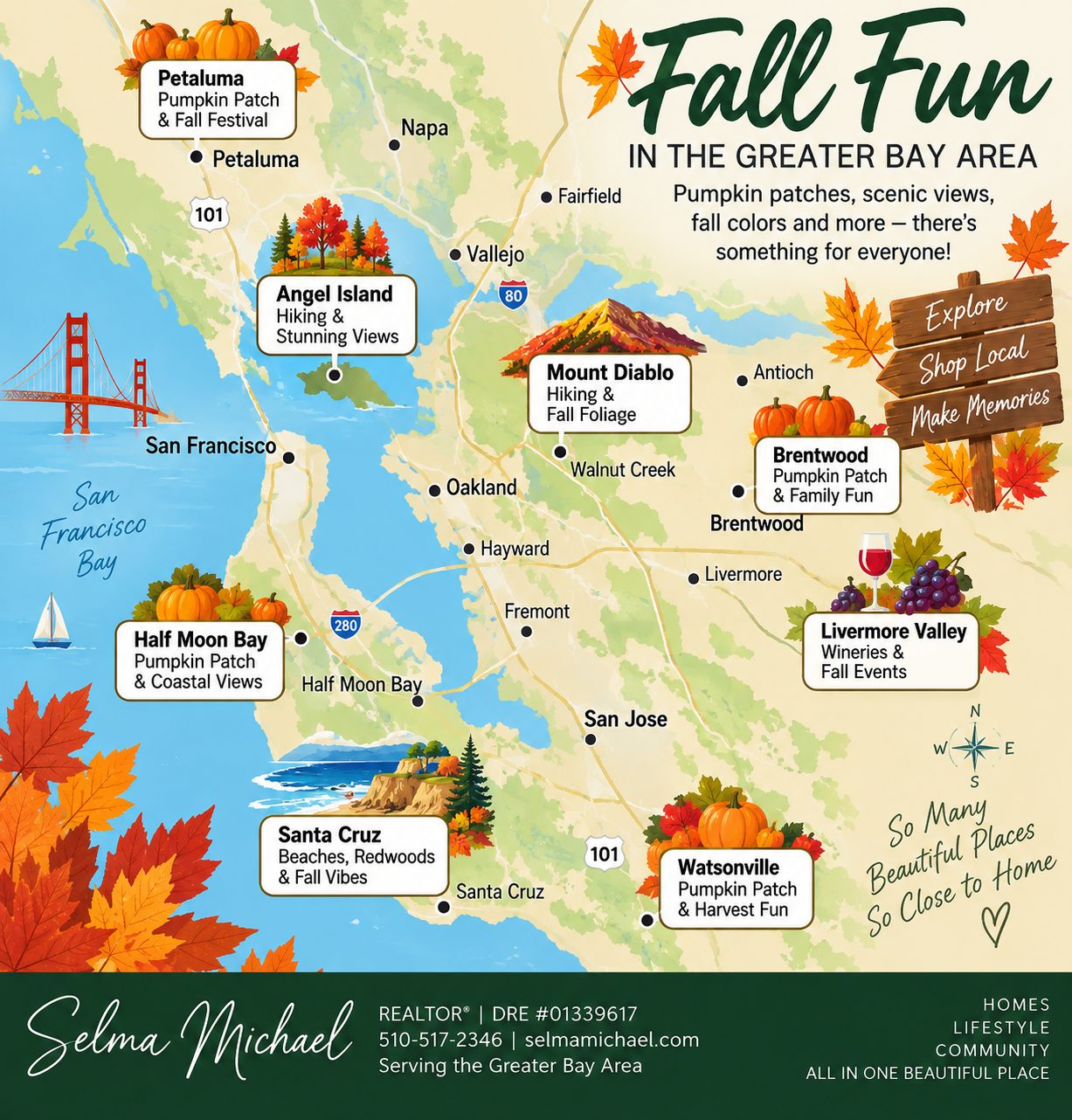
🍂 Fall Is Here: 7 Ways to Enjoy Autumn in the Greater Bay Area

Fall has officially arrived!

There is something about the beginning of fall that makes everything feel just a little different—even here in the Bay Area, where we don’t exactly wake up to frost on the pumpkins.

The mornings get cooler, the days get shorter, pumpkin spice suddenly appears everywhere, and we start thinking about weekends outdoors, cozy meals and the holidays ahead.

And don’t say we don’t have fall weather. We know we’re spoiled. 😄

One of the things I love about living in the Greater Bay Area is that we don’t have to travel very far to find something fun to do. So, in honor of the beginning of fall, here are seven ways to enjoy the season.

Table of Contents

  1. Visit a Pumpkin Patch
  2. Go Apple Picking
  3. Take a Fall Walk or Hike
  4. Visit a Farmers Market
  5. Take a Fall Day Trip
  6. Bring a Little Fall Home
  7. Start Planning for the Holidays

🎃 1. Visit a Pumpkin Patch

Is it really fall until you’ve wandered through a pumpkin patch?

We have plenty to choose from around the Bay Area. Half Moon Bay is practically synonymous with pumpkins this time of year, with numerous farms and pumpkin patches along the coast. In the East Bay, Brentwood is another fun fall destination; Three Nunns Farm, for example, is a fifth-generation working farm that grows pumpkins along with other produce.

Whether you’re bringing the kids, looking for the perfect pumpkin for your front porch, or just going for the pictures, it’s an easy way to get into the fall spirit.

Tip: Pumpkin patches are seasonal businesses, so check hours and availability before making the drive. Weather and crop conditions can change schedules.

🍎 2. Go Apple Picking

This is one of those activities that sounds like it’s just for kids—until you go and realize how much fun it actually is.

Gizdich Apple Picking in Watsonville makes a great fall day trip. Besides U-pick fruit, the ranch is known for its pies, juice and picnic area. California’s Department of Food and Agriculture specifically highlights Gizdich Ranch as a fall apple-picking destination.

Another option farther north is Chileno Valley Ranch in Petaluma, where U-pick apples are available on selected days during the season. Reservations are required for its 2026 U-pick dates.

And really, if you come home with a bag of freshly picked apples, isn’t that reason enough to make an apple pie?

🥾 3. Take a Fall Walk or Hike

We may not have New England’s fall foliage, but we have something pretty special of our own.

The East Bay Regional Park District alone has 73 parks and more than 1,300 miles of trails, including everything from easy short-loop walks to more challenging hikes.

Coyote Hills, Lake Chabot and the trails throughout the East Bay are wonderful choices when the temperatures start cooling down.

For a bigger day trip, consider Mount Diablo State Park, Angel Island State Park, or Castle Rock State Park in the Santa Cruz Mountains. California State Parks specifically recommends all three for fall outings.

Sometimes you don’t need an elaborate plan. Comfortable shoes, some water and a beautiful trail can make for a pretty great fall afternoon.

🥕 4. Spend a Morning at a Farmers Market

Farmers markets aren’t just a summer activity in the Bay Area.

Fall brings apples, pears, squash, persimmons, pomegranates and all kinds of ingredients that make you start thinking about soups, baking and those first holiday meals.

And there are farmers markets throughout the Greater Bay Area, so this doesn’t have to be a major excursion. Pick one near you, grab a cup of coffee and wander around for an hour.

It’s also a nice way to support California growers and local small businesses while discovering something you may not normally buy at the grocery store.

🚗 5. Take a Fall Day Trip

This may be one of my favorite things about living here: we have so many completely different places within driving distance.

Head to Half Moon Bay for pumpkins and the coast. Spend the day in Napa or Sonoma. Explore the Santa Cruz Mountains. Take the ferry to Angel Island. Or choose one of those little Bay Area towns you’ve driven past a hundred times but never actually stopped to explore.

The Golden Gate National Recreation Area is another wonderful fall option. The Parks Conservancy notes that autumn can bring sunny days, migrating raptors and some pockets of fall foliage—even if our leaf-peeping doesn’t quite rival Vermont.

Sometimes the best weekend plans begin with a very simple question:

“Where haven’t we been lately?”

🏡 6. Bring a Little Fall Home

You don’t have to redecorate your entire house to make it feel like fall.

A few pumpkins by the front door, a seasonal wreath, mums or other fall flowers can completely change the feeling of an entryway.

And yes, this is where the Realtor® in me comes out—I notice front porches!

A warm and welcoming entrance makes a difference whether you’re preparing your home for sale or simply coming home to it every day.

Add a cozy throw inside, light a fall candle, make your favorite soup and suddenly it feels like autumn—even if the Bay Area decides to give us an 80-degree afternoon. 😄

✨ 7. Start Looking Forward to the Holidays

This part of the year always seems to fly.

One minute we’re picking pumpkins, and the next we’re planning Thanksgiving dinner and wondering when the holiday lights went up.

Over the next couple of months, I’ll be sharing more local ideas here, including some of the best pumpkin patches, holiday light displays, seasonal events, Thanksgiving favorites and other fun things to do around the Greater Bay Area.

Because real estate may be my business, but homes are about much more than buying and selling.

They’re about the communities we live in and the memories we make while we’re there.

🍁 What’s Your Favorite Thing About Fall?

Now I want to hear from you.

What do you love most about fall in the Bay Area?

Pumpkin patches? Cooler evenings? Football? Apple pie? Halloween? Getting outdoors? Or are you already counting down the days until the holidays?

Whatever it is, I hope you find a little time to get out and enjoy this beautiful season.

Happy Fall! 🍂

Selma Michael, REALTOR®
DRE #01339617
510-517-2346
selmamichael.com
Serving the Greater Bay Area

Uncategorized • September 22, 2026

What’s Really Happening in the East Bay Housing Market?

What’s Really Happening in the East Bay Housing Market?

Alameda & Contra Costa County Market Update — August 2026

If you’ve been wondering whether the East Bay real estate market is slowing down, heating up, or simply changing, you’re not alone.

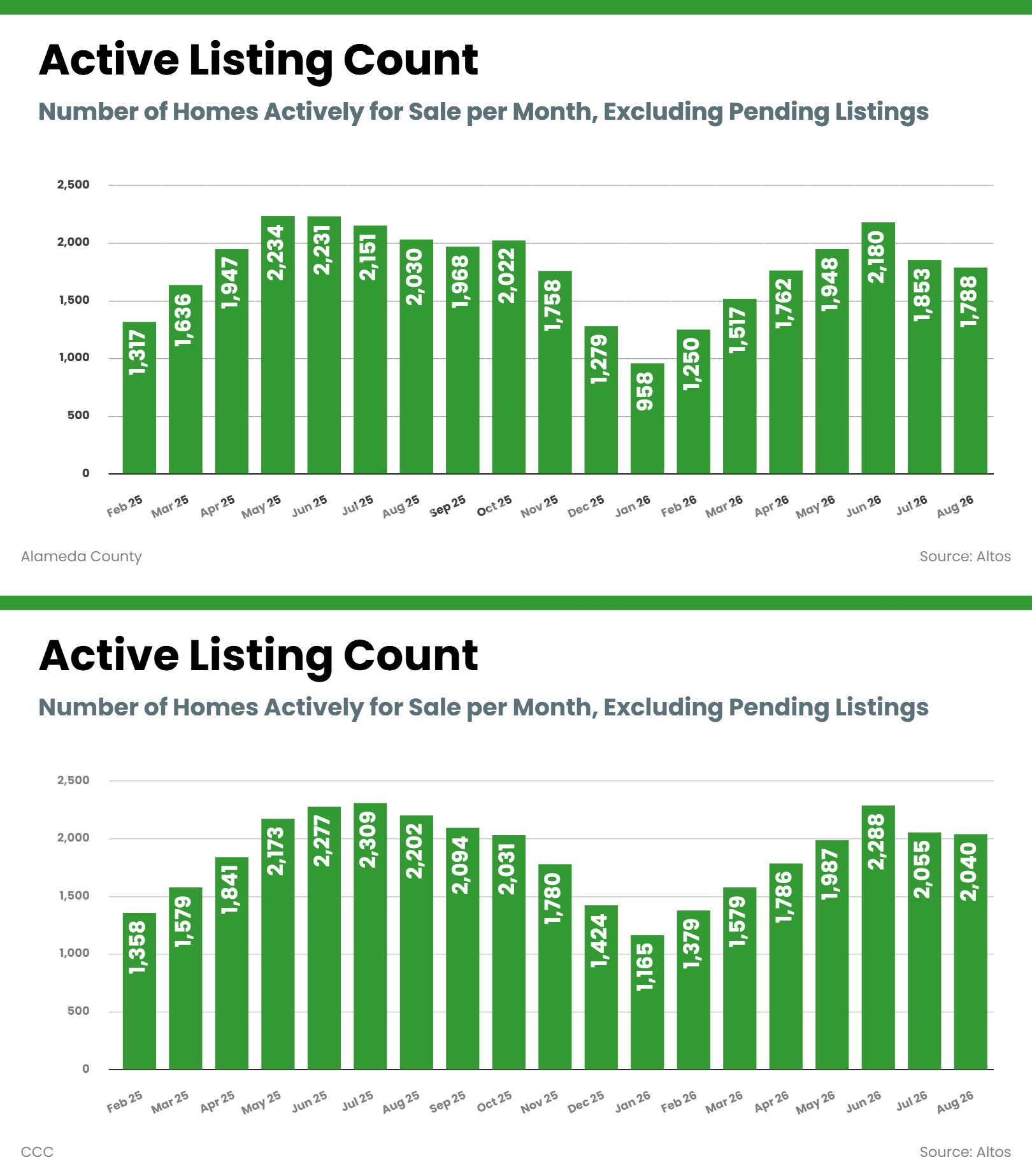
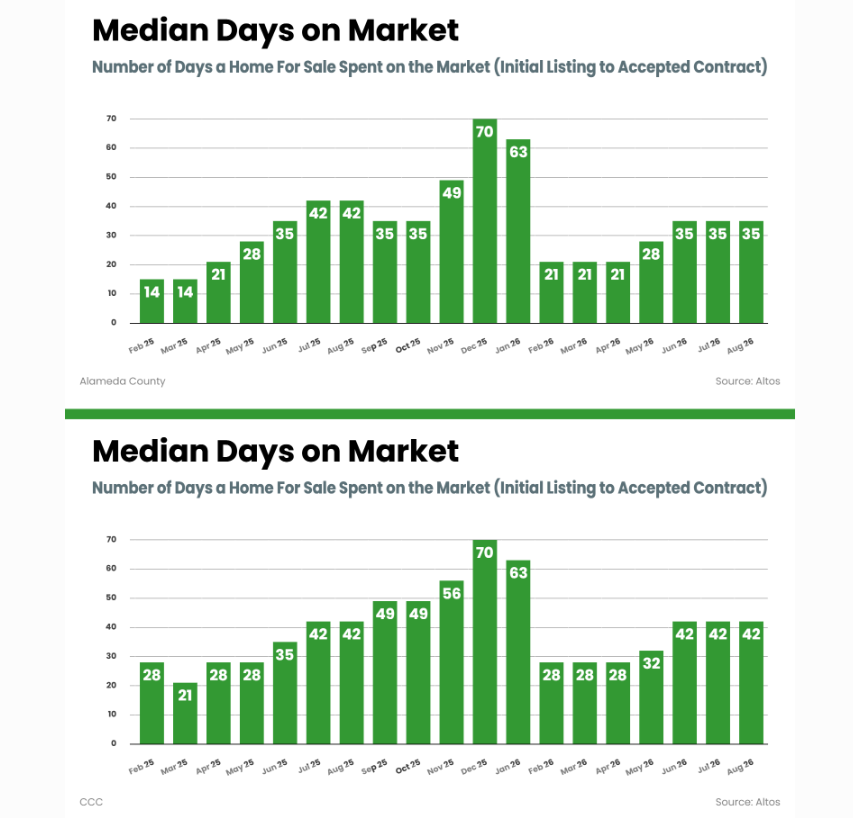
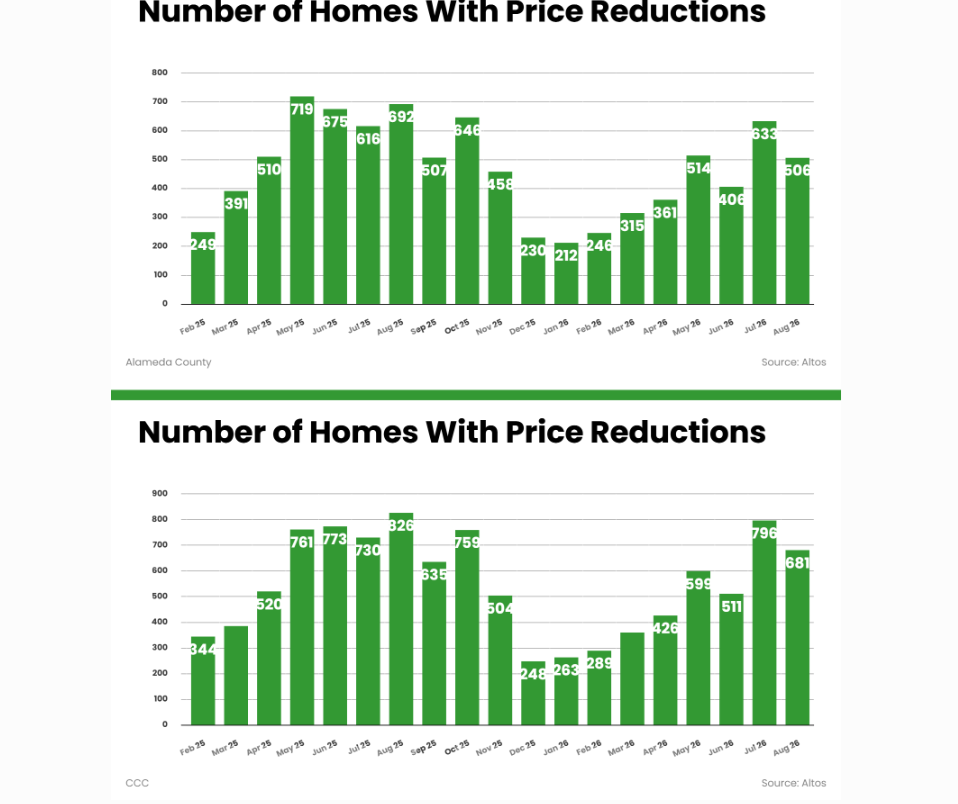
The latest housing numbers from Alameda and Contra Costa counties tell an interesting story. Buyers have more homes to choose from, properties are taking a little longer to sell, and we’re seeing more price reductions.

But that doesn’t mean homes aren’t selling.

It means the market has shifted—and strategy matters.

Table of Contents

  1. More Homes Are Available
  2. Buyers Are Still Buying
  3. Homes Are Taking Longer to Sell
  4. Price Reductions Tell an Important Story
  5. What This Means for Sellers
  6. What This Means for Buyers
  7. The Bottom Line

More Homes Are Available

One of the biggest changes we’re seeing is inventory.

In Alameda County, there were 1,788 active listings in August, compared with only 958 in January. In Contra Costa County, there were 2,040 active listings in August, compared with 1,165 in January.

For buyers, that’s welcome news. More inventory means more choices and potentially a little more breathing room when deciding which home is right for you.

For sellers, however, more inventory means more competition. Your home isn’t just competing on price—it’s competing for buyers’ attention.

Buyers Are Still Buying

More homes on the market does not mean buyers have disappeared.

In August, Alameda County had 1,372 pending listings, while Contra Costa County had 1,235 pending listings.

That’s important because it shows that homes are still going into contract.

The difference is that today’s buyers often have more choices. They can compare properties, pricing, condition and location before deciding which home deserves their offer.

Homes Are Taking Longer to Sell

This is another number sellers should pay attention to.

The median days on market in Alameda County was 35 days in August, compared with 21 days in February.

In Contra Costa County, the median was 42 days in August, compared with 28 days in February.

That doesn’t mean something is wrong with a home if it doesn’t sell the first weekend.

It does mean sellers may need to adjust their expectations. Preparation, presentation, marketing and—especially—pricing can make a significant difference.

Price Reductions Tell an Important Story

Here’s one of the statistics I find particularly interesting.

In August, 506 homes in Alameda County had price reductions. In Contra Costa County, that number was 681.

For sellers, that’s an important reminder: pricing correctly from the beginning matters.

Today’s buyers have access to an enormous amount of information. They can see competing listings, how long a property has been on the market and whether the price has already been reduced.

Sometimes sellers want to “test the market” with a higher price.

But when buyers have more choices, an overpriced home can lose valuable attention during those important first weeks on the market.

What Does This Mean for Sellers?

Today’s market doesn’t mean sellers can’t get excellent results.

It means having the right strategy from the beginning is increasingly important.

Your home’s condition, photography, marketing, presentation and pricing all work together. When buyers have more homes to choose from, you want yours to stand out for the right reasons.

And remember: real estate is local.

What’s happening across an entire county doesn’t necessarily tell us what’s happening in your neighborhood—or even in your particular price range.

What Does This Mean for Buyers?

Buyers may finally have something that has been difficult to find in many Bay Area markets:

More choices.

More inventory and longer market times may give buyers additional opportunities to compare homes and, in some situations, negotiate.

But don’t assume every seller is ready to negotiate.

A well-priced home in a desirable location can still attract significant interest. That’s why looking at the specific property and its local market is so important.

The Bottom Line

So, is the East Bay real estate market slowing down?

I’d describe it a little differently:

The market is changing.

There are more homes available. Properties are generally taking longer to sell than earlier this year. We’re seeing a meaningful number of price reductions.

At the same time, buyers are still buying and homes are still going into contract.

For both buyers and sellers, this is a market where good information and a good strategy matter.

If you’re wondering what your home might be worth—or what these numbers mean for your particular neighborhood—I’d be happy to take a closer look with you.

There is never any pressure. Sometimes you just need good information before deciding what comes next.

Selma Michael, REALTOR®
DRE #01339617
510-517-2346
selmamichael.com
Serving the Greater Bay Area

Market data source: Altos Research. Data reflects Alameda and Contra Costa County market statistics through August 2026. Market conditions vary by city, neighborhood, property type and price range.